

If you already know how a VA assumption works, the hard part is usually the equity gap, and a second lien is often how buyers close it. An interest only HELOC can be a flexible option, but the terms affect your payment, your risk, and your exit. One thing that surprises many buyers is that the rate is usually variable, so unlike the VA loan, the payment can change.
Why a HELOC Works as the Second Lien
A home equity line of credit (HELOC) is a common loan secured by the home that can sit in second position behind the assumed VA loan. On a $650,000 purchase with a $450,000 assumed balance, the equity gap is $200,000, and a HELOC can fund part or all of that amount. VA guidance allows this when the second lien is subordinate, properly documented, and included in your debt to income ratio.
A HELOC is a common choice because many lenders already offer them in second position, and the assumed VA loan can stay in place with its low rate. The catch is that many lenders will not offer the HELOC unless they are the company holding the original VA loan, so ask early who is willing to lend behind it. The interest only draw period can also keep the minimum payment lower at first, and you can pay down principal faster when your budget allows.
How Much the Lender Will Fund
The term Combined Loan to Value (CLTV) is how the second lender measures its risk. It is the total amount of loans secured by the property divided by the property value. As CLTV increases, the HELOC lender takes on more risk because there is less equity protecting its second position.
The lender will only lend up to its CLTV limit, so you bring cash to cover whatever is left between the total financing and the purchase price. A 90% CLTV is fairly common, while some lenders may cap it at 80% or go as high as 100%. Guidelines vary by lender, so you need to confirm what is actually available. On a $650,000 purchase with a $450,000 VA balance, the amount of cash you need changes based on that CLTV limit.
| Item | 80% CLTV | 90% CLTV | 100% CLTV |
| Purchase price | $650,000 | $650,000 | $650,000 |
| Assumed VA loan balance | $450,000 | $450,000 | $450,000 |
| Maximum total loans | $520,000 | $585,000 | $650,000 |
| HELOC available | $70,000 | $135,000 | $200,000 |
| Cash you bring for the gap | $130,000 | $65,000 | $0 |
Note: The 90% column is highlighted because it is a common planning assumption, but your lender may be higher or lower. This example is for illustration only and leaves out the VA funding fee, closing costs, and lender fees. Confirm current figures and terms with your lender.
How the Interest Only Draw Period Works
Most HELOCs start with a draw period, often 5 to 15 years, followed by a repayment period. During the draw period, the minimum payment is interest only. That means you pay only the interest the lender charges, and none of it reduces the balance. If you only make the minimum payment, you will still owe the full amount when the draw period ends.
The interest only payment is the amount drawn, multiplied by the rate, divided by 12. If the line is fully drawn at closing to pay the seller, you owe interest on that entire amount from day one. Unlike the VA loan, the HELOC rate is usually variable. It is typically based on the prime rate plus a margin, which is a set amount the lender adds on top. Prime is a benchmark banks use for lending rates and it moves as interest rates change, so your payment can go up or down. For example, at an 8% rate, $135,000 costs about $900 a month in interest. If the rate rises to 9%, that becomes about $1,013.
Note: Rates and margins change often. Confirm current figures and terms with your lender.
Paying Down Principal for Flexibility
With this type of HELOC, if you want to reduce the balance, you need to pay more than the minimum payment each month. Every extra principal payment lowers the balance, which also lowers the next interest only payment. You are not locked into a fixed principal payment.
Picture a military family that plans to be in the home for about three years, but when they move, the assumed mortgage does not quite cash flow as a rental. If they steadily pay down the HELOC while they live there, the payment gets smaller while rents may increase. That could make the difference between keeping the property as a rental and feeling like they have to sell. Say they add $500 a month toward principal and put a one time $10,000 BRS bonus toward the balance in year 2. The chart shows what happens to the payment on a $135,000 line.
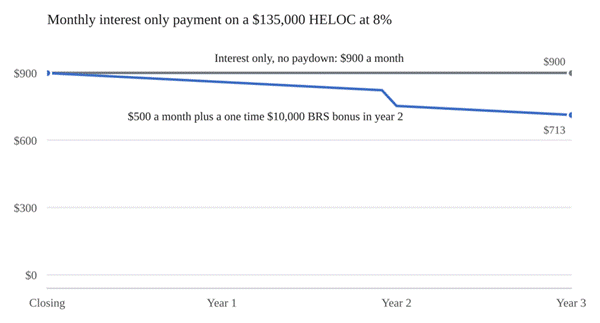
Note: This example assumes the rate stays at 8%, that you add $500 of principal each month, and that you make one $10,000 principal payment in year 2. Confirm current figures and terms with your lender.
Benefits and Risks
The benefits are using less cash at closing and keeping the low rate VA mortgage. The risks matter just as much.
- The variable rate means your payment can increase.
- Principal payments become required after the draw period, which can raise the payment.
- High leverage leaves you more exposed if property values drop.
- At 100% CLTV, you start with no equity cushion if values decline.
- You still have to qualify for both loans, with the HELOC payment included in your debt to income ratio.
The Bottom Line
An interest only HELOC can be a workable second lien if the lender allows it and the budget still works at a higher rate. If the deal only works at 100% CLTV with no room for the payment to increase or anything else to go wrong, buying may not make sense. Our guide on calculating your blended rate shows how a HELOC changes your overall cost, and you can run your own numbers in the VA Loan Assumption Calculator.
If you’re weighing a VA assumption, reach out and I’m happy to walk through your specific numbers.
This article is provided for educational purposes only and does not constitute legal, tax, financial, or lending advice. Real estate rules, rates, loan requirements, and market conditions vary by situation, location, and loan type. Before making any real estate decision, consult a licensed attorney, CPA, lender, or other qualified professional
Frequently Asked Questions
Can I use an interest only HELOC as the second loan on a VA loan assumption?
Often yes, but it depends on the lender. VA guidance allows a second lien when it is subordinate to the VA loan, properly documented, and included in your debt to income ratio. Many lenders will not offer the HELOC unless they are also the company holding the original VA loan, so ask early who is willing to lend behind it.
How much cash do I need if I use a HELOC to cover the equity gap?
It depends on the lender's combined loan to value (CLTV) limit. On a $650,000 purchase with a $450,000 assumed VA balance, an 80% CLTV means a $70,000 HELOC and $130,000 cash. At 90% the HELOC is $135,000 and cash is $65,000, and at 100% the HELOC is $200,000 and cash is $0. This leaves out the VA funding fee, closing costs, and lender fees.
Is the interest rate on a HELOC fixed or variable?
It is usually variable. The rate is typically based on the prime rate plus a margin, so your payment can go up or down. For example, at 8% a $135,000 balance costs about $900 a month in interest only, and at 9% it becomes about $1,013.
Does an interest only HELOC payment pay down the loan?
No. During the draw period, which is often 5 to 15 years, the minimum payment covers interest only and none of it reduces the balance. If you want to lower the balance, you need to pay more than the minimum, and each extra principal payment also lowers your next interest only payment.
What are the biggest risks of using a HELOC as a second lien?
The main risks are a payment that can rise with the variable rate, required principal payments after the draw period, and higher leverage if property values drop. At 100% CLTV you start with no equity cushion. You also have to qualify for both loans with the HELOC payment included in your debt to income ratio.