
The assumed rate on a VA loan is the number that makes assumptions compelling. When a seller holds a loan at 3% and today’s market sits above 6%, that gap in rates represents real monthly savings. But when you need additional financing to cover the seller’s equity, the assumed rate tells only part of the story.
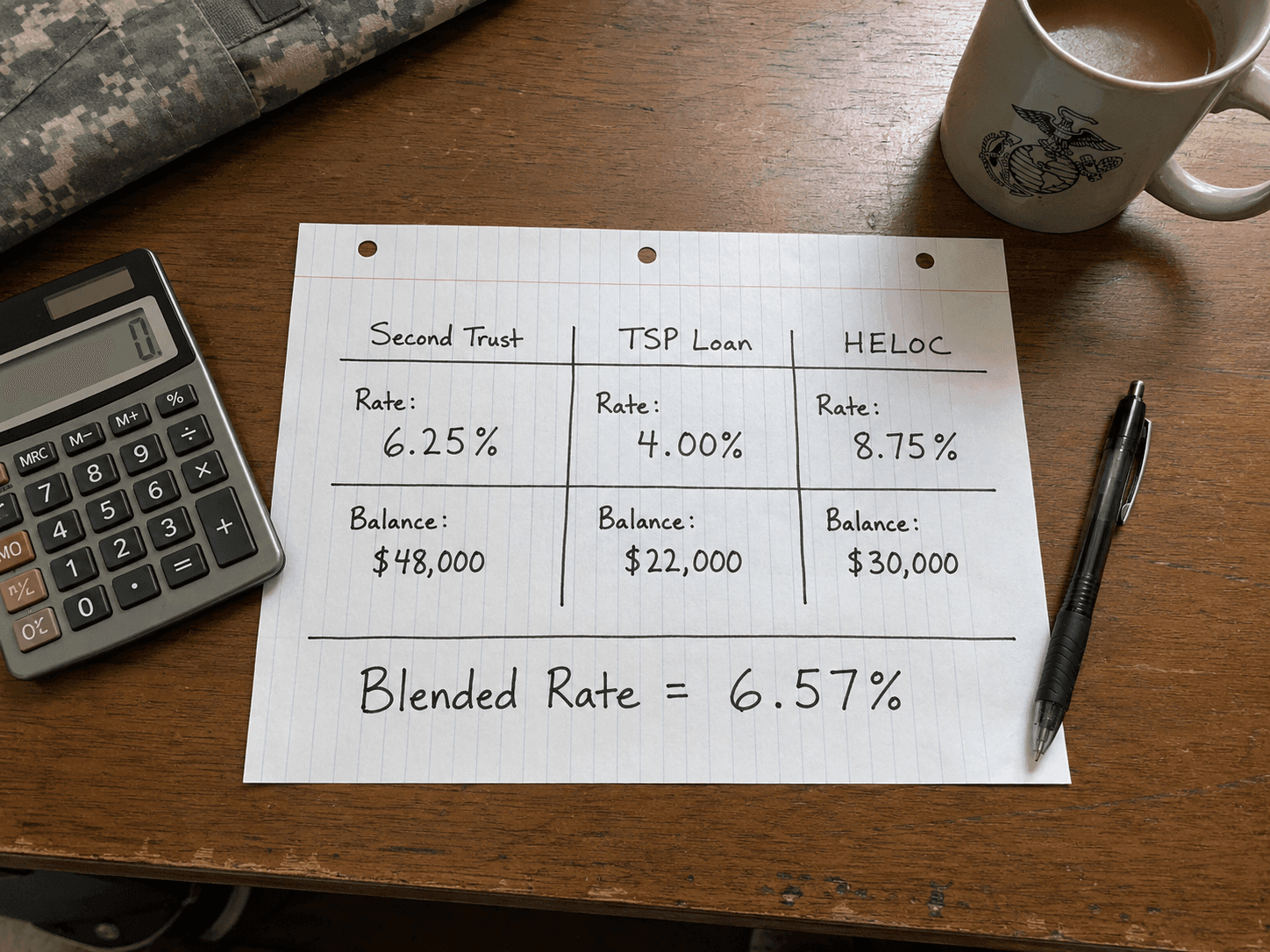
The rate you actually pay across the full transaction is a weighted average of every source of funds. That figure is your blended rate, and it is the number worth understanding before you commit to an assumption.
How the Blended Rate Formula Works
The calculation is straightforward. Multiply each loan balance by its interest rate to find the annual interest cost for that portion. Add those totals together. Divide by the combined loan amount.
Blended rate = (Balance A x Rate A + Balance B x Rate B) / Total borrowed
The result is the single rate that reflects your overall cost of debt, weighted by how much of your total balance sits at each rate. A small, expensive second trust does less damage to the blend than a large one. A TSP loan at 4.5% barely moves the needle on a $350,000 first mortgage. A $122,000 second trust at 9.5% moves the blend more, but the $350,000 first at 3% still anchors the weighted average below market.
Three Blended Rate Examples
All three examples below use the same starting point: a $350,000 assumed VA loan at 3% on a $525,000 purchase. Each scenario funds the $175,000 equity gap differently. The cash-to-close column shows how much the buyer brings to the table in addition to any borrowed gap funds. The second trust scenario reflects the 89.99% CLTV ceiling most second trust lenders apply: $525,000 x 89.99% = approximately $472,000 maximum combined debt, which caps the second trust at $122,000 and requires $53,000 in cash.
| Ex. 1: Second Trust | Ex. 2: TSP Loan | Ex. 3: HELOC | |
| Assumed VA Loan | $350K at 3.00% | $350K at 3.00% | $350K at 3.00% |
| Gap Financing | $122K 2nd trust at 9.5% | $50K TSP loan at 4.5% | $80K HELOC at 8.5% |
| Cash to Close | $53,000 | $125,000 | $95,000 |
| Total to Purchase | $525,000 | $525,000 | $525,000 |
| Total Borrowed | $472,000 | $400,000 | $430,000 |
| Annual Interest (1st) | $10,500 | $10,500 | $10,500 |
| Annual Interest (gap) | $11,590 | $2,250 | $6,800 |
| Blended Rate | 4.68% | 3.19% | 4.02% |
| New VA Loan at 6.50% | 6.50% | 6.50% | 6.50% |
| Rate Advantage | -1.82% | -3.31% | -2.48% |
Note: All figures are illustrative. Second trust rate reflects a 9.5% rate as referenced in market conditions at time of writing. The $122,000 second trust carries an estimated monthly payment of approximately $1,578 on a 10-year term at 9.5%. HELOC rate reflects 8.5% for an investment property or prior-residence line. TSP rate is the G Fund rate, which was 4.25% to 4.5% in early to mid 2026. New VA loan rate of 6.50% is used as a market benchmark. Confirm current rates with your lender before making any decisions.
In all three scenarios the blended rate beats a new VA loan on rate alone. The TSP loan produces the lowest blend because its rate is only 1.5 points above the assumed first mortgage. The second trust at 9.5% moves the blend the most, but the $350,000 first at 3% still anchors the weighted average below market. The larger the gap and the higher the gap rate, the more that advantage erodes.
What to Do With Cash
The cash-to-close column in the table above shows the buyer’s equity contribution, but cash is excluded from the debt-only blended rate calculation because it carries no interest rate. That is mathematically correct, but it can understate the true cost.
Cash has an opportunity cost: every dollar used to close the gap cannot earn returns elsewhere. For a more conservative comparison, some buyers assign cash an estimated opportunity cost rate, such as the yield on a high-yield savings account or a conservative investment return, and include it in the blend. This is not required, but it gives a more complete picture when comparing the assumption against investing that cash and taking a new VA loan instead.
What the Blended Rate Does Not Tell You
Monthly payment. A second trust, TSP loan, and HELOC each carry separate repayment schedules with different terms. Two deals with the same blended rate can have very different monthly obligations and cash flow impacts.
Variable-rate risk. A HELOC at 8.5% today may be higher in 18 months if the Federal Reserve raises rates. The blended rate you calculate today will not be the blended rate you live with if gap financing is variable.
Closing costs and timeline. Assumptions take 45 to 90 days to close and carry their own fees. A new VA loan closes faster with a more predictable cost structure.
Liquidity after closing. The cash-to-close amounts above are real money leaving your account. The TSP loan example requires $125,000 in cash. That is not a small number, and whatever is left in savings after closing is your only buffer until the property generates income or you build equity back up.
Comparing the Assumption Against a New VA Loan
A fair comparison stacks the full assumption deal against a new VA loan on the same property. The four numbers to line up are: blended rate versus new VA rate, combined monthly payment versus new VA payment, total interest over your expected hold period, and closing costs on each path.
A new VA loan at 6.5% on $525,000 produces one payment, one rate, no gap financing, and a simpler qualification process. The assumption produces a lower blended rate in all three examples above, but it requires servicer approval, secondary financing coordination, a longer closing timeline, and the management of multiple obligations. The assumption wins on rate. The new VA loan wins on simplicity, speed, and liquidity.
The break-even question is how long you need to stay in the home for the rate savings to offset the upfront gap costs and financing complexity. For military buyers with short or uncertain PCS timelines, this is the most important calculation to run before committing. For a complete look at VA loans and other financing options side by side, see Loan Options for Military Buyers.
Putting It All Together
The blended rate does not make the decision for you, but it gives you the right number to work with. The assumed VA rate is the headline. The blended rate is the reality. When you know both, you can compare an assumption directly against a new VA loan without overstating or understating the benefit.
The sequence for evaluating any assumption is: calculate the gap, identify your funding sources, run the blended rate formula, and compare against a standard VA purchase at current market rates. Use the gap funding article to work through your sources, then bring those numbers back to this formula to see where you actually land.
If you want to run this calculation for a specific assumption you are evaluating, reach out at pjburns@combatproperties.com.
This article is provided for educational purposes only and does not constitute legal, tax, financial, or lending advice. Real estate rules, rates, loan requirements, and market conditions vary by situation, location, and loan type. Before making any real estate decision, consult a licensed attorney, CPA, lender, or other qualified professional.