
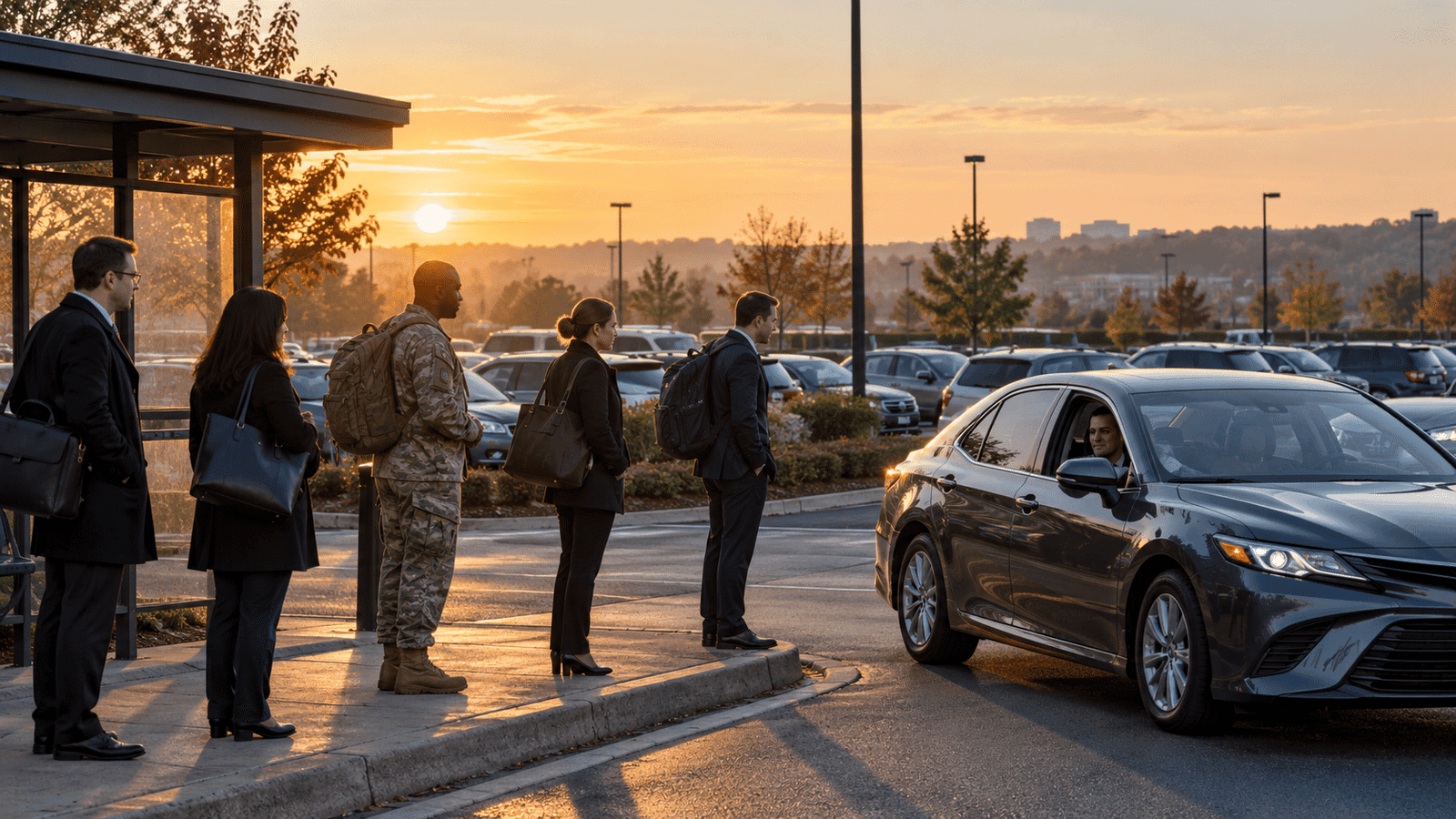
Slugging is a free, no-commitment, no-schedule commute that thousands of Northern Virginia drivers and riders already use every weekday along the I-95/I-395 corridor. A driver needs three people in the car to ride the Express Lanes for free, a rider needs a way to the Pentagon or DC without buying a ticket, and the two sides meet at a known pickup spot without a sign-up and no money involved. It sounds informal because it is, but it runs on real rules riders learn fast.
How Slugging Actually Works
A driver heading into the city pulls up to a known slug line and calls out or holds up a sign naming the destination, usually the Pentagon, Crystal City, Rosslyn, or somewhere downtown. Riders stand in line, and whoever is first in line going that way gets in. No app, no reservation, no payment changes hands. The driver gets a free ride through the Express Lanes’ HOV-3 requirement, and the rider gets a free trip in return. It is a trade, not a service, which is part of why it has lasted decades without a company behind it.
Lines form at well-established commuter lots rather than random street corners, running from Fredericksburg and Stafford through Prince William into Fairfax County on the morning side. Afternoon lines reverse the pattern, picking up at the Pentagon, Crystal City, Rosslyn, plus several DC drop points for the ride home. The graphic below labels every stop along the corridor, so there’s no need to memorize a list here. Pickup points shift occasionally as construction, policy, or demand changes them, so confirm your nearest current line on sluglines.com or by downloading the app before building a commute plan around one.
The Unwritten Rules
Slugging has an etiquette, and regulars enforce it without much patience for newcomers who skip it. Riders don’t talk unless the driver starts a conversation, and even then, keep it light since the driver is often making calls or just wants quiet. Don’t touch the radio or the climate controls. No eating, drinking, smoking, or grooming in someone else’s car. Seatbelts on every time, and keep phone calls short if you take one at all. Above everything else, no money changes hands, ever, and offering any marks you as someone who hasn’t done this before.
Lines run strictly first-come, first-served, and either side can pass. A driver going somewhere slightly different can wave the next rider in line forward; a rider uncomfortable with a particular car can step back, waiting for the next one instead. Nobody owes an explanation either way.
Why Drivers Actually Do This
The math is straightforward. Driving the Express Lanes solo from Fredericksburg to the Pentagon costs a real toll that climbs with congestion, while a car carrying three or more people rides free under HOV-3 once the E-ZPass Flex is switched to HOV mode. Picking up two slugs turns an expensive solo toll into a free, faster trip in the same lanes everyone else is paying to use. Live traffic on the general lanes versus the Express Lanes is worth checking before you commit to a route, and expresslanes.com’s live traffic map shows current conditions on both.
One quirk worth knowing: a driver dropping slugs near the Pentagon can exit northbound at Eads Street, drop off, and re-enter the Express Lanes at that same exit to continue into D.C. without an extra charge, provided the Flex is switched to toll mode before continuing. The system still logs the carpool trip at that exit point, which is why Eads Street functions as an informal slug drop-off even though it isn’t marked that way.
If You Work South: The Reverse-Commute Reality
Slug lines exist because of demand, and the demand runs one direction at a time, north into D.C. in the morning and south out of it in the afternoon. A rider living in Arlington or Alexandria who works south toward Marine Corps Base Quantico will not find a slug line built for that trip, since nobody is lining up to ride south at 7 AM. Reverse commuters are generally better served by driving solo in the general lanes, since there is no informal rideshare pool to tap heading that direction. A vanpool is a more realistic option for a true reverse commute, since vanpools are organized around a fixed group rather than whoever happens to be standing in line.
Putting It All Together
Slugging works well for anyone settling near one of the established I-95 or I-395 pickup points who commutes into the Pentagon, Crystal City, Rosslyn, or downtown D.C. on a standard weekday schedule. It costs nothing, needs no app, and gets you access to Express Lane speeds that a solo driver pays a real toll for. For the full Fredericksburg-to-Pentagon picture, start with our original commute guide.
If you’re weighing a home near a slug line against one near a bus stop or train station, reach out, happy to walk through which commute actually fits your routine.
See Your Slugging Options on the Map
This article is provided for educational purposes only and does not constitute legal, tax, financial, or lending advice. Real estate rules, rates, loan requirements, and market conditions vary by situation, location, and loan type. Before making any real estate decision, consult a licensed attorney, CPA, lender, or other qualified professional.
Frequently Asked Questions
What is slugging and how does it work?
Slugging is a free, informal carpooling system along I-95 and I-395. Drivers pick up riders at known commuter lots to meet the Express Lanes’ three-person HOV requirement, and riders get a free trip to the Pentagon, Crystal City, Rosslyn, or downtown D.C. No app, no payment, and no reservation are involved.
Where are the slug line pickup points?
Established commuter lots run from Fredericksburg and Stafford through Prince William into Fairfax County on the morning side, with afternoon lines picking up at the Pentagon, Crystal City, Rosslyn, and several DC drop points for the ride home. Pickup points shift occasionally, so confirm your nearest current line on sluglines.com before planning around one.
Do I have to pay to slug?
No. No money changes hands in either direction. Offering to pay actually marks you as unfamiliar with how slugging works, so it’s best avoided.
What are the basic rules of slugging?
Don’t talk unless the driver starts the conversation, don’t touch the radio or climate controls, no eating or drinking in the car, and keep phone calls short. Lines run strictly first-come, first-served, and either the driver or the rider can pass without explanation.
Does slugging work for a reverse commute to Quantico?
Not really. Slug lines exist because of one-directional demand, north into D.C. in the morning and south in the afternoon. A rider working south toward Marine Corps Base Quantico won’t find a slug line built for that trip. A vanpool is a more realistic option for a true reverse commute.